
The funding protocoltraders don’t have to trust.
DecentralProp is a launchpad for tokenized autonomous prop-firms on Solana. Anyone can launch a firm on it, and every evaluation, funded account and payout settles on-chain where a trader can check it.
Open-source · audit-ready infrastructure
 Settled on Solana
 Programs in Anchor
 Liquidity via Raydium
 Tokens via Metaplex
 Charts by TradingView
 Proven on DecentralChain
Traders getting paid, on-chain
Payouts to funded traders, across every firm on the protocol, settled on Solana devnet. Each card shows who was paid, how much, and which firm paid them. None of it is typed in by hand: open a card for that trader's full record, or open the transaction and check it on a devnet explorer yourself.
These are devnet transactions denominated in test SOL, not money. The protocol runs end to end on devnet today, which is what makes the record above checkable before anyone has risked anything. Mainnet opens September 2026.
Firms in the factory
The top three by proven payouts — traders funded, payout liquidity, solvency coverage, and a $YOURFIRM token you can buy on its curve. The figures read straight off Solana.
Devnet transactions, in test SOL. Mainnet opens September 2026. What's live today
Every figure is read live from Solana — treasury, payouts, solvency and bonding-curve price. Each firm's $FIRMA mint is on-chain and yours to verify. Firms are listed once their token is live and they have signed up their first traders.
Deploy your own fully autonomous prop firm in under 90 seconds
Two wallet signatures. The firm, its treasury, its token and its curve are created by one atomic transaction. Everything below arrives with it.
- FirmState account — your firm's identity on Solana
- Treasury PDA — self-custodied, readable by address
- $YOURFIRM mint on a fixed-supply bonding curve
- Loss-back credit vault
- Payout waterfall bound to your treasury
The operator console
Traders, evaluations, analytics, payouts, compliance and your storefront — the same admin the protocol runs on.
A branded storefront and terminal
Your name, your colours, your domain. Custom domains attach with a CNAME; nothing is rebuilt per firm.
The autonomous risk engine
Eight sensors score your firm every sweep and set what you can safely sell. No risk desk to hire, and no rules for you to tune.
Your own token and curve
$YOURFIRM launches with a fixed supply, a bonding curve holding real SOL, and a reserve held back for payouts.
A share of every fee your firm earns
Your treasury takes the majority leg of your launch fee and a tier-scaled share of every evaluation sold. Vesting and the full ladder are in the economics act below.
Affiliate and marketing machinery
On-chain referral carve and claim, plus the acquisition surfaces — leaderboards and a daily giveaway — already wired.
No KYC, paid to their wallet
Wallet sign-in, on-chain withdrawal. No identity documents and no review desk that can hold a payout.
A real desktop and mobile terminal
USD-notional sizing rather than lots, a live evaluation rail, and charts on the same feeds the engine prices from.
Rules frozen at purchase
Evaluation terms are hash-committed per account when it is bought. The engine can tighten terms for future buyers; it never retightens an account already trading.
A payout they can verify
Every completed payout carries a signature that resolves on an explorer, published on your firm's public page.
Comeback credits on a failed attempt
A loss-back fee leg mints an on-chain credit toward a future evaluation, so a failed attempt is not a total loss.
A public happiness score for your firm
A live 0–100 score the risk engine recomputes each sweep, published whether it flatters the firm or not.
What you do not get is the ability to change the outcome. Evaluation rules, leverage and account sizes are platform-fixed and enforced on-chain, and a completed payout is delivered by a program rather than approved by you. You set the brand, the storefront and the profit-split preset. What an operator controls
Every market, on day one
Crypto, US equities, FX and metals: 254 instruments on one funded account, priced from the same feeds and sized in dollars rather than lots. There are no data agreements to negotiate and no brokers to wire up. The catalog ships with the engine your firm runs on.
- BitcoinBTCUSD
- AppleAAPLUSD
- Euro / DollarEURUSD
- GoldXAUUSD
- NvidiaNVDAUSD
- SolanaSOLUSD
- Dollar / YenUSDJPY
- TeslaTSLAUSD
- EthereumETHUSD
- SilverXAGUSD
- S&P 500 ETFSPYUSD
- Pound / DollarGBPUSD











- MicrosoftMSFTUSD
- XRPXRPUSD
- Pound / YenGBPJPY
- AmazonAMZNUSD
- DogecoinDOGEUSD
- PlatinumXPTUSD
- GoogleGOOGLUSD
- ChainlinkLINKUSD
- Aussie / DollarAUDUSD
- MetaMETAUSD
- AvalancheAVAXUSD
- Nasdaq 100 ETFQQQUSD










- CoinbaseCOINUSD
- SuiSUIUSD
- Dollar / LoonieUSDCAD
- MicroStrategyMSTRUSD
- CardanoADAUSD
- CopperXCUUSD
- NetflixNFLXUSD
- PolkadotDOTUSD
- Dollar / FrancUSDCHF
- AMDAMDUSD
- LitecoinLTCUSD
- PalantirPLTRUSD











- RobinhoodHOODUSD
- CosmosATOMUSD
- Kiwi / DollarNZDUSD
- TSMCTSMUSD
- UniswapUNIUSD
- PalladiumXPDUSD
- ASMLASMLUSD
- ArbitrumARBUSD
- Euro / YenEURJPY
- GameStopGMEUSD
- InjectiveINJUSD
- OracleORCLUSD










One catalog, shared by every firm on the protocol. The risk engine sets leverage per instrument class, not the operator. How trading works
What your traders see
Two screens from Trustless Funding, the first firm deployed on the protocol. Every deployment runs this same terminal. The name, the colours and the domain are the operator's.
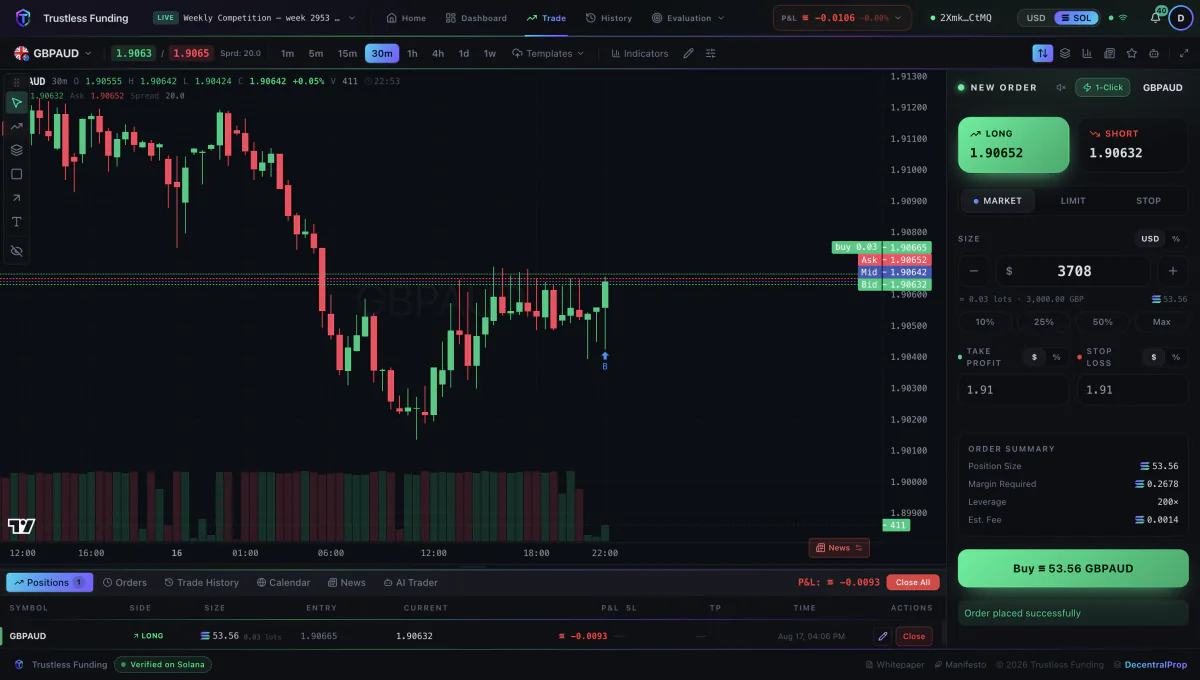
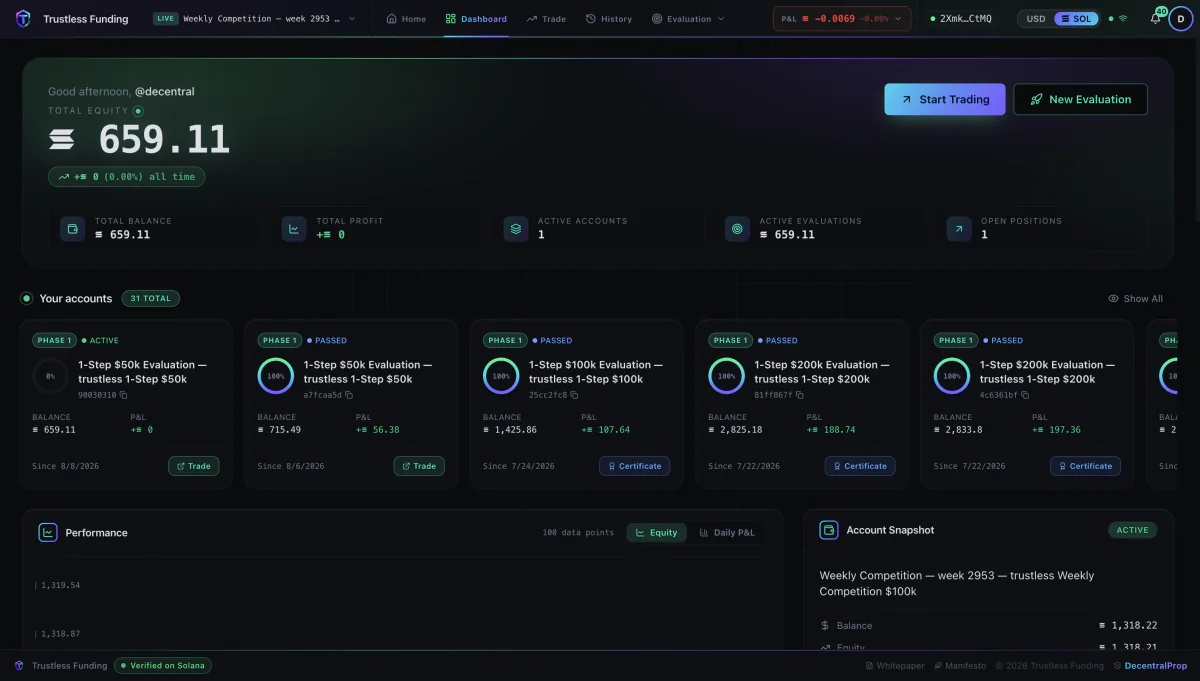
Size in dollars, not lots. The spread, the margin and the fee are all on the ticket before you send it, and the fill lands in the positions table underneath.
A proven, multi-billion-dollar industry
You're not betting on an unproven idea. The retail "funded trader" model is already one of the fastest-growing businesses in online finance — household names like FTMO, Topstep, FundedNext and The Funded Trader have proven it at billion-dollar scale: sell evaluations, fund the few who pass, keep the rest. It works. It's just centralized, opaque and custodial. DecentralProp is the same proven economics — rebuilt as a decentralized, on-chain, autonomous protocol.





Independent companies, shown to identify the industry this model comes from. No affiliation, endorsement or partnership is claimed. All marks belong to their owners.
Same model. Different structure.
The centralized model's only real weakness is trust: a trader cannot verify the firm is solvent, that a fill was the market, or that a payout will arrive. None of these rows is a better number at the same game. They are differences a competitor cannot close without becoming a different kind of company.
| Dimension | A centralized prop firm | A firm on DecentralProp |
|---|---|---|
| Who holds the money | A private company bank account. You take its word for the balance. | An on-chain treasury PDA. Anyone can read the balance at any moment. |
| Payout speed | A review queue measured in days to weeks, with no published clock. | Settled on Solana and timed. The median is published on this page. |
| Identity checks | KYC documents before a payout clears — the most common stall point. | A wallet. No ID, no review desk that can hold a payout. |
| Who fills your orders | An internal dealing desk. You cannot tell the market from the house. | Committed seeds and prices hash-chained before use. Replay any fill and check the hash. |
| When rules change | Terms get reinterpreted, often right as a withdrawal is requested. | Terms are hash-committed per account at purchase. Tightening hits new buyers only. |
| If they run out of money | Payouts stop. Traders join a creditor queue with no on-chain trail. | A programmed waterfall: treasury → token reserve → backstop → insurance. |
| Rejected payouts | Not published. | Published, per firm, with the reason. |
The left column describes common practice across the centralized retail prop industry, not any one company. DecentralProp is not affiliated with the firms named above.

The autonomous prop firm
A prop firm is normally a company: a risk desk deciding who gets funded, a payouts team deciding when you get paid, a compliance queue deciding whether to look at your account again. Here every one of those is a program on a schedule. You are not buying software that helps you run a firm. You are deploying a firm that runs.
An evaluation's result is committed on-chain as a replayable transcript, proposed, watched and finalized by keepers. No human signs off on a pass or a fail.
Enqueued, delivered on-chain, and released from the queue when a cap frees up. A payout the engine cannot pay today is queued, never cancelled.
Every firm is re-scored on a sweep and its tier moved, with no risk desk and no discretion. This is the ARE, below.
Cross-firm collusion, copy-trading and hedge rings are detected on a sweep, and every hold-release path runs from the same job.
Balances reconciled against the chain, $FIRMA bought back into the payout reserve, the bonding curve graduated and its LP added when it completes.
A trader can open one without permission, and the fault proof runs on-chain. A firm posts a bond against its own honesty before it can sell anything.
Name, logo, colours, domain, storefront.
What an evaluation costs, within a guided range.
One preset. The engine can pay above it at the Trusted tier, never below the platform floor.
That is the entire list. Drawdown limits, the profit target, minimum trading days, account sizes and leverage are platform-fixed and server-enforced, which is what lets a trader compare two firms on price and service without auditing either one's risk rules.
The jobs themselves run on protocol infrastructure, so this is automation rather than a claim that nobody is behind it. What matters is what they are permitted to do: the money moves along rules in open programs, so a keeper that stalls delays a payout and a keeper that misbehaves cannot redirect one.
The engine that keeps it solvent
Take the risk desk out of a prop firm and something has to do its job. The ARE is a closed control loop that runs on every firm: it reads eight sensors, rolls them into a single 0–100 risk score, maps that to one of four tiers, and moves six sets of levers that can only ever tighten from the owner's baseline as risk rises, never below it.
Drag the risk score. Watch what the engine does.
The real scoring band and the real tier configuration, applied to the platform-fixed rulebook every firm shares. The terms move continuously, not in steps.
Terms ramp continuously inside a band rather than snapping at its edge, so a firm one point into Strained is treated almost exactly like a firm at the top of Standard. The score itself is separately smoothed over time, rising fast and falling slow, and a relax time-lock plus hysteresis stop a firm oscillating across an edge.
Green is better than the owner's baseline. Amber is a tightening. Terms are frozen on your account at purchase, so a firm sliding down this scale never changes an evaluation already running.
Every state the engine can put a firm in
Four tiers, and there is never a fifth. Each column shows the range a band covers as the score moves through it. A difficulty ceiling keeps even Critical statistically winnable, and an earned payout is only ever delayed or queued.
| Tier | Profit split | Profit target | Max drawdown | Min days | Cooldown |
|---|---|---|---|---|---|
Trusted score 0–25 | 85% | 7% | 10% | Not enforced | None |
Standard score 25–48 | 85% → 80% | 7% → 8% | 10% → 9% | Not enforced | None |
Strained score 48–68 | 80% → 72% | 8% → 9.5% | 9% → 8% | 5 → 6 | None → 7d |
Critical score 68–100 | 72% → 60% | 9.5% → 12% | 8% → 7% | 6 → 9 | 7d → 14d |
The sensors it reads
Read-only measurements of a firm's solvency and behaviour. Ninety-seven of the hundred points measure something the firm controls; three measure the market, deliberately.
Payouts owed against the treasury and its buffer. The most direct solvency signal there is.
How fast the treasury is draining, taking the worse of the 7-day and 24-hour outflow.
Payout obligations against fee inflow. Above 1.3 the fees no longer cover what is owed.
Worst-case loss across open positions, against notional and against profit already booked.
The largest single entitlement plus the top-five share. One whale that could tip the book.
The unfilled fraction and the age of the oldest queued request. What a stuck firm looks like.
The rate of detected behavioural abuse across the firm's accounts.
Asset volatility measured from our own price history. Exogenous, so deliberately light-touch.
The levers it moves
As risk rises, these tighten in lockstep — but a compounding-difficulty ceiling guarantees the result always stays winnable, and earned payouts are only ever delayed, never cancelled.
Profit split, loyalty bonuses and soft caps. At the Trusted tier the split is rewarded above the owner's baseline.
Per-wallet cooldowns, single-payout and weekly caps. Over-cap payouts are queued and auto-released — never refused.
Profit target, drawdown, min-days and consistency — interpolated smoothly off the score, capped so evals stay winnable.
Spread, slippage, min-hold and price-age tighten under stress — disabled in provably-fair mode.
Leverage, position-size and open-position reductions, always as a fraction off the firm's baseline.
A firm never stops selling (sales refill a stressed treasury); the solvency control is queuing payouts, not halting them.
A solvent firm is one that can keep paying
The ARE isn't tuned to squeeze traders — it's tuned to keep firms healthy enough to honor every payout. Its invariants are explicitly trader-protective.
Earned payouts are sacred
The ARE can delay, cap or queue a payout under stress, but it can never cancel one a trader has earned. Queued payouts auto-release via keeper.
Loyalty is rewarded
Repeat winners earn a rising split bonus, and a healthy 'Trusted' firm pays its traders above the owner's own baseline split.
What you get, what it costs, and how to check it
One question each, answered properly. Launch fees start at $1K and top out at $50K, paid once.
Your firm
The machine the protocol deploys, the product your traders actually use, and a token that is yours. Not a SaaS rental, and not a white-label agreement.
See what deploysPricing
Five tiers from $1K to $50K. What a higher tier really buys, what every tier shares, and where each dollar of the fee goes on-chain.
Compare the tiersSecurity and simulations
Five open programs against a verified build, and the 300-firm, 540-day, 14-scenario economy we ran before any of this went live.
Read the evidence
“In this industry a firm's payout record is a marketing claim. Here it's an address.”
“I could never prove I was cheated.”